Boost Local SEO with Review Responses: How Nearby Customers Find You
Replying to Google reviews can strengthen your Maps profile and local search CTR, and it turns every review into one more reason to choose you.

A guest leaves you five stars. The text? "Great food, friendly staff." Your fingers go straight to the keyboard: "Thank you so much, we look forward to your next visit." Polite. Safe. And a missed opportunity.
Because today, a reply to a review isn't read only by the person who wrote it. Dozens of other guests read it too, often right before they decide whether to book a table, a room or stop by for a coffee. And it's also read by systems that build a picture of your business from publicly available text.
Replying to reviews stopped being just a courtesy to one customer a long time ago. It's a small but effective tool for building trust, local visibility and GEO (Generative Engine Optimization). Used sensibly, every reply can keep working for you for months.
What exactly is GEO and why should you care

People don't search for businesses the way they used to. They type a dry "restaurant city centre" less often and ask more questions like: "Where can I get good pancakes near the castle?" or "I need a quiet hotel in the centre, ideally with courtyard parking."
That's a real difference. Google, Maps and generative search need context, not just your business name and opening hours. They want to understand what you actually offer, where exactly you are, who you're a good fit for and what experience people keep describing.
GEO feeds on what guests write about you. But it also relies on your own replies. Review replies are fresh, public and natural text about your business. If you keep writing "thanks for visiting", you tell the world almost nothing. If you mention the quiet courtyard terrace, the homemade cheesecake, breakfast from 7:00 or that the ice rink is a short walk away, you suddenly give people and search engines something concrete to hold on to.
If you don't reply strategically, you let other people do all the talking. If you reply with intent, you help shape the picture that future guests and search systems have of you.
Switch from a bare thank you to the story of your business
Every reply to a review is a bit of free media space. A small billboard, without the rent. People don't read reviews only to find out whether someone liked their lunch. They read between the lines: do you reply like a normal person, do you notice details, can you take praise and criticism without an inflated ego.
Picture a café by a lake on the edge of the city centre. It has 4.6★ from 312 reviews and guests often praise the cappuccino. If someone writes "good coffee, nice staff", it would be a shame to reply with an empty sentence.
A plain, wasted reply: "Thanks for the rating, we're glad you enjoyed it."
A strategic reply that thinks about the audience: "Thank you for the lovely visit. We're glad our morning cappuccino hit the spot. Next time you're walking by the lake, we'd be happy to see you for our homemade apple cake or a quick coffee to go before your walk."
See the difference? In the second reply you didn't force keywords in. You simply named the location, a product and a situation the customer can picture straight away. Someone sitting in the car, looking for a café by the lake, reads this reply and knows what to do within 30 seconds.
The three pillars of a good reply
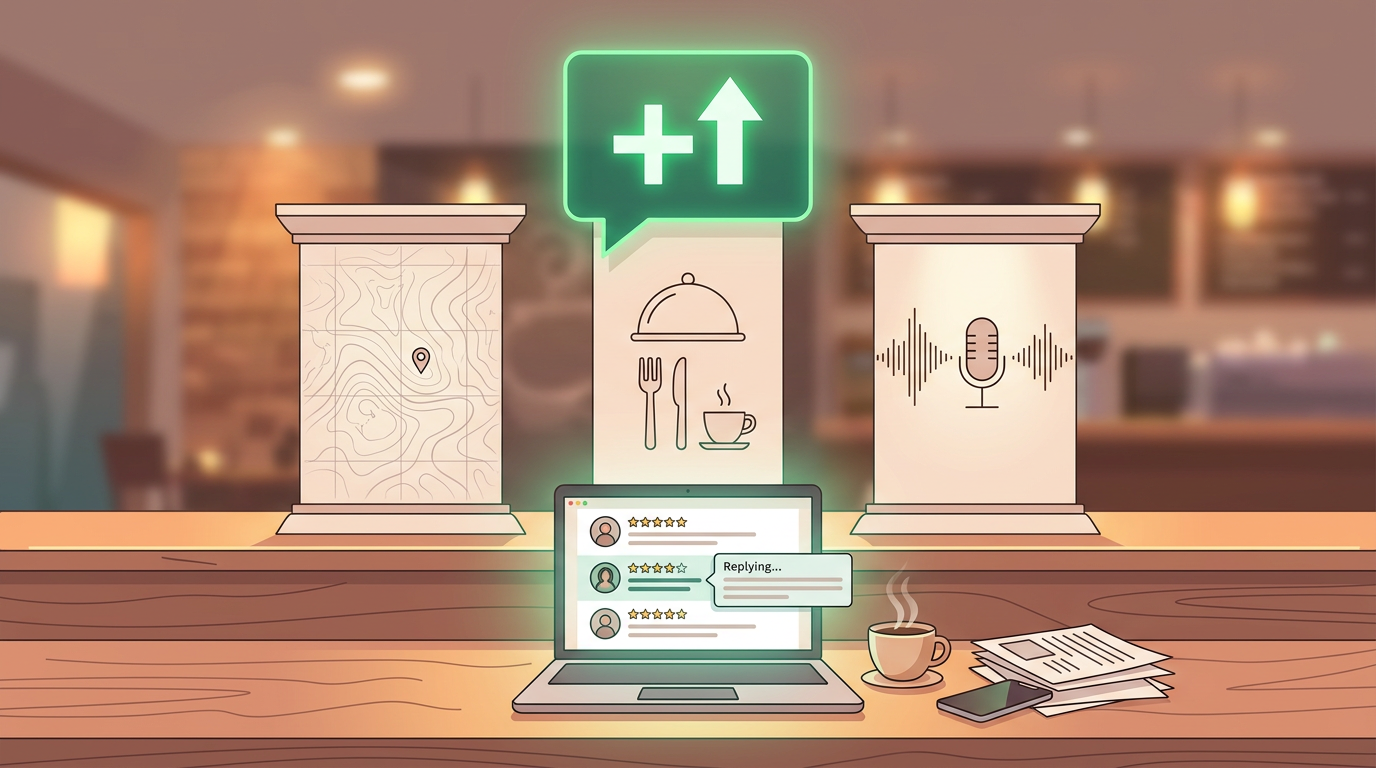
If you run a restaurant, café or guesthouse, you don't have time to write a short novel for every review. Between the bread delivery, a sick waiter and a booking for 18 people, it just wouldn't work. A simple framework helps: a good contextual reply should include at least two of these three pillars.
- Location and surroundings: Remind people where exactly you are. Not awkwardly, but naturally. "We're glad you could rest with us after your hike in the mountains." Or: "We're happy our terrace came in handy after your walk along the river." A detail like this anchors you on the map and in the reader's mind.
- Menu and details of your offer: If the guest doesn't mention a specific product, you can add one with a light touch. If they do, build on it. "We simmer our beef broth all night, so we were really pleased you noticed it at lunch." That sounds very different from a sterile "thanks for your feedback".
- Tone and experience: The reply should sound like your business. A family-run Italian restaurant can be warm and a little chatty. A boutique hotel in the city centre should stay calm, precise and elegant. Tone is your signature. Don't underestimate it.
An example from accommodation
With accommodation, guests are more careful. Naturally. They aren't choosing a bread roll for 40 cents, but a place where they will sleep, park, shower and maybe take a work call at 8:15 in the morning. So they often read the reviews with a magnifying glass.
Picture a small city hotel with a 4.3★ rating from 187 reviews. A guest writes: "Lovely room, but we missed better bathroom amenities."
Stay silent? Bad. Reply "Thanks for the suggestion"? Almost as bad. It looks as if someone dealt with the review between two emails without stopping to think about it.
Try a reply that is factual and useful for the next readers instead: "Dear guest, thank you for your honest feedback. We're glad you liked the room facing our quiet historic courtyard. We're sorry the bathroom amenities didn't meet your expectations. We're currently adding new sets of local natural toiletries, and we hope you'll notice the difference on your next visit to the city."
A reply like this doesn't turn criticism into a disaster. On the contrary, it turns it into proof that the hotel isn't resting on its laurels. The next guest learns that the rooms face a quiet courtyard, that you're working on the toiletries and that the replies aren't written by a heartless machine. For GEO, that's a valuable detail. For a person, even more so.
If you're looking for ready-made wording for different situations, you'll find it in our review reply templates.
Don't ignore negative feedback, work with it
Customers can smell a template. When the same polished sentence sits under twenty different reviews, trust drops. Fast. Nobody wants to feel they're talking to a wall in a uniform.
In general, people aren't looking for artificially flawless businesses, they're looking for businesses that genuinely care about their customers. So a negative review doesn't have to be a disaster. Sometimes it's a good stage to show the character of your business.
If a guest writes that they waited 42 minutes for Sunday lunch, don't pretend nothing happened. The reply could go like this: "We're sorry about the long wait, you're right, on Sunday between 12:00 and 14:00 the kitchen was beyond its usual capacity. Thank you, though, for appreciating the food and the service. We've already adjusted the staff rota for weekend lunches so this doesn't happen again."
That's fair. It doesn't belittle the customer, it doesn't dodge the issue and it tells other readers that you sort things out. That's exactly what builds respect. Not perfection on paper, but reality handled well.
To have something to reply to, you also need a steady flow of new reviews. How to get them within the rules is covered in our article on how to get more Google reviews.
Speed has a direct impact on decisions
Besides the quality of the text, timing matters too. A reply after four months looks like tidying up the storeroom right before an inspection. Formal, late, no pulse.
A reply within 24 to 48 hours says something completely different: the business is alive and someone is looking after its digital shop window. In smaller businesses it's often the owner in the evening after closing, in hotels the front office manager between reports. Whoever it is, the customer sees attention.
And attention can change the mood. In practice it's quite common for someone to change an overly harsh rating from 2★ to 4★ after a polite reply, or to add that the owner looked into the problem. Not always, of course. But often enough that it pays to reply quickly and to the point.
Keep your strategy and your sanity with Reputo
But let's be honest: when your place is full and you're dealing with stock, shifts, invoices, sick staff and a broken coffee machine on top of it, keeping track of reviews in several places starts to get on your nerves. Google here, another portal there, a notification in your inbox, something gets buried on your phone. And suddenly you have five unanswered reviews that are three weeks old.
This is where Reputo makes sense. Reputo tracks new reviews from Google (and, from the PRO plan, from Booking.com) and gathers them in one clear place, so you don't have to open a pile of tabs every morning and hunt for what's new. From one place, it helps you prepare replies that make sense, carry local context and keep a consistent brand voice.
The goal isn't to make everything sound like a polished template. Quite the opposite. Reputo is there to save you the routine, so you have room to add the detail only someone from the business knows: that the terrace is at its best after 17:00, that your cheese comes from a particular farm, or that courtyard parking needs to be booked in advance. The process gets faster, but the replies keep their human touch.
Every public sentence about your business helps someone decide. Sometimes a customer, sometimes a search engine, often both at once. Give your replies precision, a bit of local flavour and a normal human tone. Over time, it will show in your reputation, your visibility and your footfall.
FAQ
What exactly does GEO mean when it comes to customer reviews?
GEO (Generative Engine Optimization) means optimising for search and answers powered by artificial intelligence. While customers describe their impressions in reviews, your replies add concrete context for search engines and AI assistants: where exactly you are and what makes you stand out for your target audience.
Isn't a simple "thank you" enough as a reply to a review?
A "thank you" is basic courtesy, but on its own it doesn't use the reply's potential. When you work in a mention of a specific dish the guest praised or a well-known landmark nearby, you build a richer picture. That helps both people and maps or AI search understand the local context of your business.
Is it important to reply to negative reviews?
Criticism is a good chance to show future customers who you are. People read carefully how you handle problems. A factual, specific and polite reply to a complaint shows other readers of your profile that you're a professional and that the customer experience matters to you.
How can Reputo help me manage reviews?
Reputo tracks new reviews from Google (and, from the PRO plan, from Booking.com) and gathers them in one place. For each one it suggests a reply in your brand voice and, once you approve it, publishes it directly to your Google Business Profile. You handle replies from one interface, with a consistent tone and without reviews waiting weeks for a response.